Emotions Worksheets
Printable worksheets that help children name, understand and manage their feelings. The pack covers emotion identification, faces to draw and match, a feelings thermometer, triggers and body clues, calming strategies and a daily feelings check-in — for home, classrooms and counselling sessions.
Emotions Worksheets for Kids
Nine printable feelings worksheets — identification, faces, thermometer, body clues, triggers, calming strategies, check-ins and journal — plus emotion word cards.
- Name that feeling (PDF, DOCX)
- Draw the face (PDF, DOCX)
- Feelings thermometer (PDF, DOCX)
- Body clues (PDF, DOCX)
- Triggers & solutions (PDF, DOCX)
- Calm-down strategies menu (PDF, DOCX)
- Daily feelings check-in (PDF, DOCX, XLSX)
- Feelings journal (PDF, DOCX)
- Emotion word cards (PDF, DOCX)
Formats: PDF, DOCX, XLSX. Instant download after payment (link valid 72 hours, up to 5 downloads). AI-assisted: the templates were drafted with AI help and reviewed and laid out by Kedop.
$6.00 USD, one-time
Secure card checkout by Stripe. Full refund within 7 days — see the refund policy and license.
What is in the emotions worksheet pack
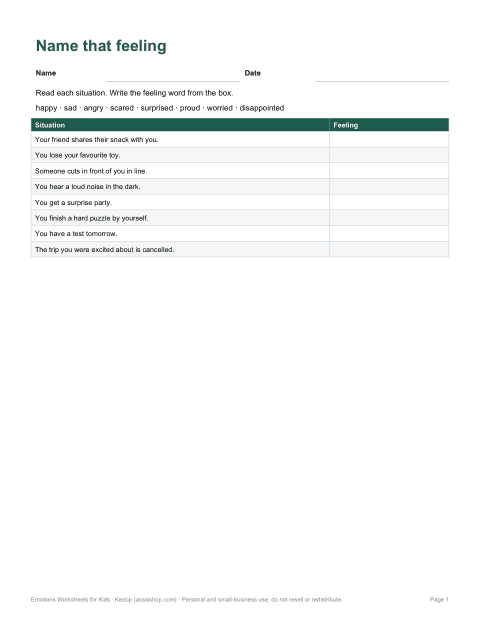
- Name that feeling — match emotion words to situations and faces.
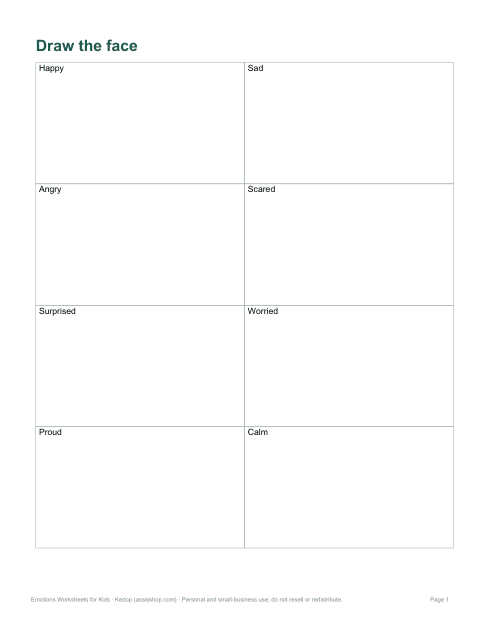
- Draw the face — children draw faces for happy, sad, angry, scared, surprised, worried, proud and calm.
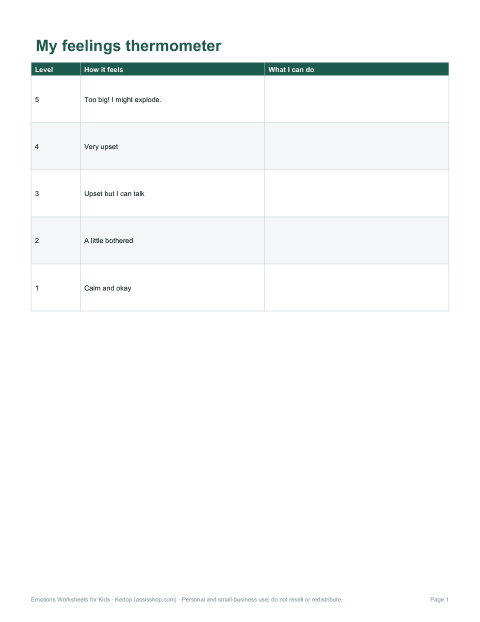
- Feelings thermometer — rate how strong a feeling is from 1 to 5 and what each level looks like.
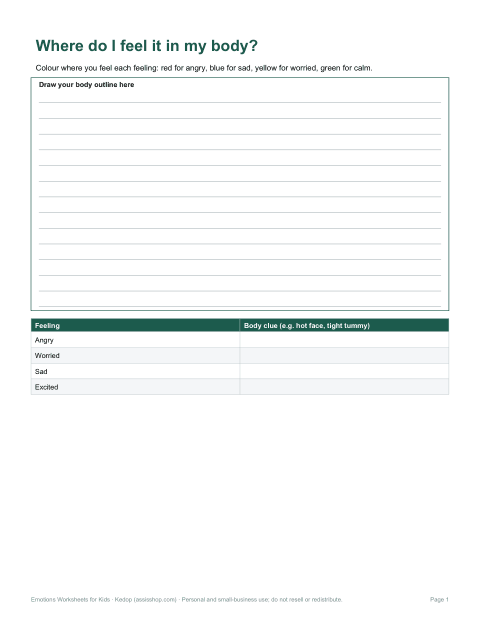
- Body clues — where do I feel it in my body? A body outline to colour.
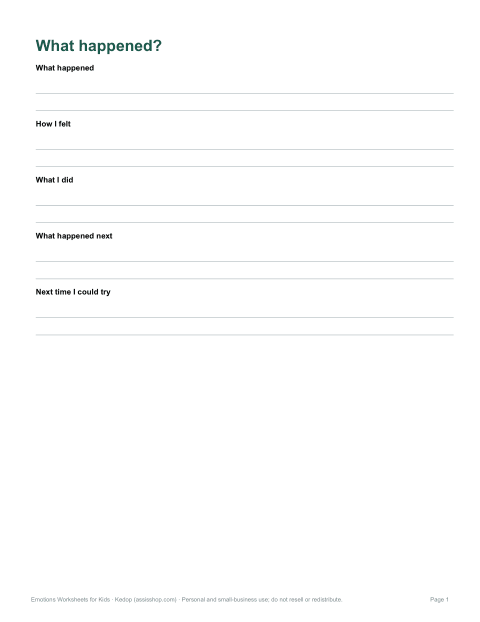
- Triggers and solutions — what happened, how I felt, what I did, what I could try next time.
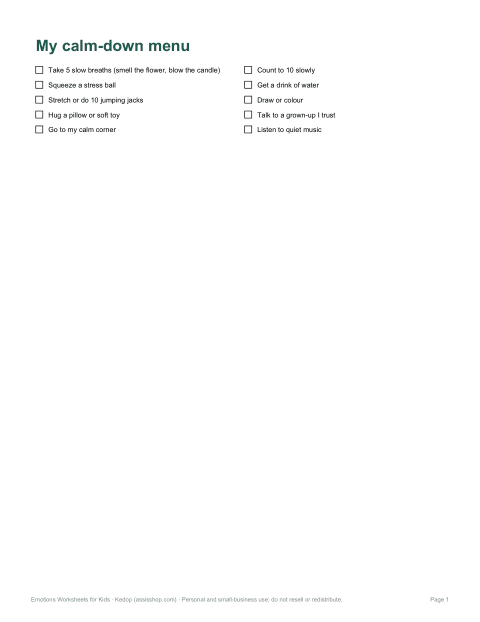
- Calm-down strategies menu — breathing, movement, sensory and talking strategies to choose from.
- Daily feelings check-in — a quick morning or afternoon chart for a week.
- Feelings journal pages — prompts for older children.
- Emotion word cards — for games, sorting and vocabulary building.
Why emotion vocabulary matters
Children who can name a feeling precisely — frustrated rather than just “bad”, nervous rather than just “scared” — are better able to understand what is happening inside them and to ask for the help they need. Building this emotional vocabulary is a core part of social-emotional learning (SEL), which many schools teach alongside academic subjects. The worksheets start with basic feelings for younger children and add more nuanced words, such as disappointed, jealous, embarrassed and hopeful, for older ones.
How to use the worksheets
- Start with the “Name that feeling” and “Draw the face” sheets to build vocabulary.
- Use the feelings thermometer when things are calm, so the child learns the scale before they need it.
- Explore body clues: many children notice a feeling in their body before they can name it.
- Choose three calming strategies together and practise them when calm.
- Use the triggers sheet after a difficult moment has passed, not during it.
- Keep the daily check-in visible so talking about feelings becomes routine.
Tips for adults
- Model it: name your own feelings out loud in everyday situations.
- Validate first — “You seem really frustrated” — before problem-solving.
- Make clear that all feelings are acceptable, while not all behaviours are.
- Keep sessions short and positive; five to ten minutes is plenty for young children.
- Praise effort in using a strategy, even if it does not work every time.
- If a child's distress is frequent, intense or getting worse, talk to their doctor, school counsellor or a mental health professional.
Who it is for
Parents, early-years and elementary teachers, school counsellors, therapists and after-school programmes. The simpler sheets suit ages 4–7 with adult support; the journal pages and trigger-solution sheets suit ages 7–12. The worksheets are educational tools and are not a substitute for professional assessment or therapy.
Formats
Every worksheet is a print-ready PDF (US Letter, also printable on A4) and an editable DOCX file, so you can change wording, add a child's name or adapt activities. Emotion word cards print six per page.
Using the sheets in a classroom routine
Many teachers begin the day with a quick feelings check-in: each child points to or names how they feel on the chart, which helps the teacher notice who might need extra support. Weekly, a short lesson with one worksheet — a new emotion word, a calming strategy or a role-play from the triggers sheet — builds skills gradually. Displaying the calm-down menu in a quiet corner gives children a place to use the strategies they have practised, and returning to the thermometer after a difficult moment helps them see that strong feelings do pass.
Frequently asked questions
What age are these emotions worksheets for?
Roughly ages 4–12, with simpler sheets for younger children and journal-style sheets for older ones.
Can I use them in therapy sessions?
Yes, counsellors and therapists can use them as activities; they do not replace professional judgement.
Are the worksheets editable?
Yes, every sheet comes as an editable Word file as well as a PDF.
How many worksheets are included?
Nine worksheet types plus emotion word cards.
Was AI used to create them?
The worksheets were drafted with AI assistance and then reviewed, edited and formatted by Kedop.